QUICK TAKEAWAYS
- Frame packs significantly reduce fatigue on longer journeys
- Internal frames excel in brush; external frames offer better ventilation
- Water resistance is non-negotiable for protecting essential gear
- Invest more in your pack than most other gear — it affects overall comfort
- Choosing the right bushcraft pack requires considering load weight and travel distance
The pack you choose for your bushcraft adventures will be one of the most important decisions you make. Your bushcraft pack will carry all of your other gear and can be the difference between an enjoyable experience and a terrible one. In this post, I will show you how to choose the right bushcraft pack for your needs.
A bushcraft pack differs from everyday backpacks in several important ways. Unlike school or commuter backpacks designed for light loads and short distances, a proper bushcraft pack features reinforced stitching, durable materials, ergonomic weight distribution systems, and specialized attachments for outdoor tools. This distinction becomes critical when you’re miles from civilization carrying everything needed for self-sufficiency.
When I first started buying gear for my adventures in the great outdoors, I didn’t have much money at all. What little bit I had couldn’t be “wasted” on hobbies. There was gas and groceries to buy for my growing family.
The situation being as it was, I often bought the cheapest gear I could find. In my mind, cheap gear was better than no gear at all. This included my hiking pack.
I started out with a regular backpack you would buy for school. It wouldn’t take long for my neck and shoulders to become fatigued and start to cramp. I thought it was just me and I just needed to toughen up and get my body used to carrying the load. After a couple of months of hiking and a hunting trip through the mountains of Wyoming, I began to suspect my pack. You have to understand that I didn’t have access to all the great sources of online information we have today and I didn’t really know anyone else who was into hiking.
Key Considerations for how to choose the right Bushcraft Pack
The two most important things to consider when choosing the right bushcraft pack are:
- How much will you be carrying?
- How far will you be traveling?
For capacity planning, consider these general guidelines:
- Day trips: 20-35 liters
- Overnight trips: 40-50 liters
- Weekend trips (2-3 days): 50-65 liters
- Extended outings (4+ days): 65+ liters
Remember that bushcraft typically requires more tools than ultralight backpacking, so err on the higher side of these ranges if you carry traditional tools like axes or larger knives.
As a rule of thumb, aim to keep your fully loaded pack under 20-25% of your body weight for comfortable travel. For a 175-pound person, that means keeping your pack around 35-45 pounds maximum. Your fitness level and terrain difficulty will affect what’s comfortable, but exceeding this ratio significantly increases fatigue and injury risk.
For a deeper look at gear weight planning, check out this REI guide on backpacking weight.
If you are only going to have one pack, you should prepare for the worst-case scenario. The worst case is having to carry all of your gear for several miles. Not only all the gear you have now, but any gear you hope to gain in the near future. A good pack should last for several years and so you should plan on accommodating any gear you plan to add in that time frame.
If you have an average kit, you should consider getting a pack with a frame. If you are not used to carrying a pack, you have no idea how much difference a frame makes to your comfort and stamina. The frame helps to transfer some of the load off of your shoulders. When choosing the right bushcraft pack, you can opt for an internal or external frame. Each has its advantages.
External Frame vs. Internal Frame Comparison
| Feature | External Frame | Internal Frame |
|---|---|---|
| Cost | Generally less expensive | Usually more expensive |
| Weight distribution | Higher on back, more vertical transfer to hips | Lower on back, closer to center of gravity |
| Carrying capacity | Excellent for heavy loads | Good for moderate loads |
| Climate performance | Better ventilation in hot weather | Warmer in cold weather |
| Attachment options | Multiple external attachment points | Fewer attachment points but cleaner profile |
| Brush navigation | Prone to snagging | Streamlined, less catching |
| Balance on terrain | Higher center of gravity | Lower center of gravity, better stability |
| Long-hike comfort | Frame may create pressure points | Padded against back, fewer pressure points |
An external frame is normally a little less expensive. It will carry the load higher on the back which helps transfer the load more vertically to your hips. It seems to me this helps you carry a little more weight. In warmer climates, an external frame may keep you slightly cooler because the frame provides separation between the pack and your back. The external frame also provides ample places to hang or strap accessories, like the Kelty Coyote 85.
An internal frame pack generally has more room inside than an external. It will keep all of your gear inside and protected. It will also present a smaller profile and you can compress the pack tighter thus taking up less room. Since the pack is smaller and there is no exposed frame, it is also an advantage when you are in thick brush. Internal frames also ride a little lower on the back which can help with balance. The enclosed frame can also be more comfortable over extended hiking periods as the metal frame is padded from the hiker’s back, as seen in the Helikon-Tex Bergen.
General Price Guidelines
- Budget packs ($50-100): Typically frameless or minimal internal support, like the Teton Sports Explorer 4000
- Mid-range packs ($100-200): Good internal or external frames, adequate for most users Like the Helikon-Tex Bergen, or the Kelty Coyote 85
- Premium packs ($200-350+): Enhanced durability, superior support systems, specialized features like the Mystery Ranch Terraframe 65
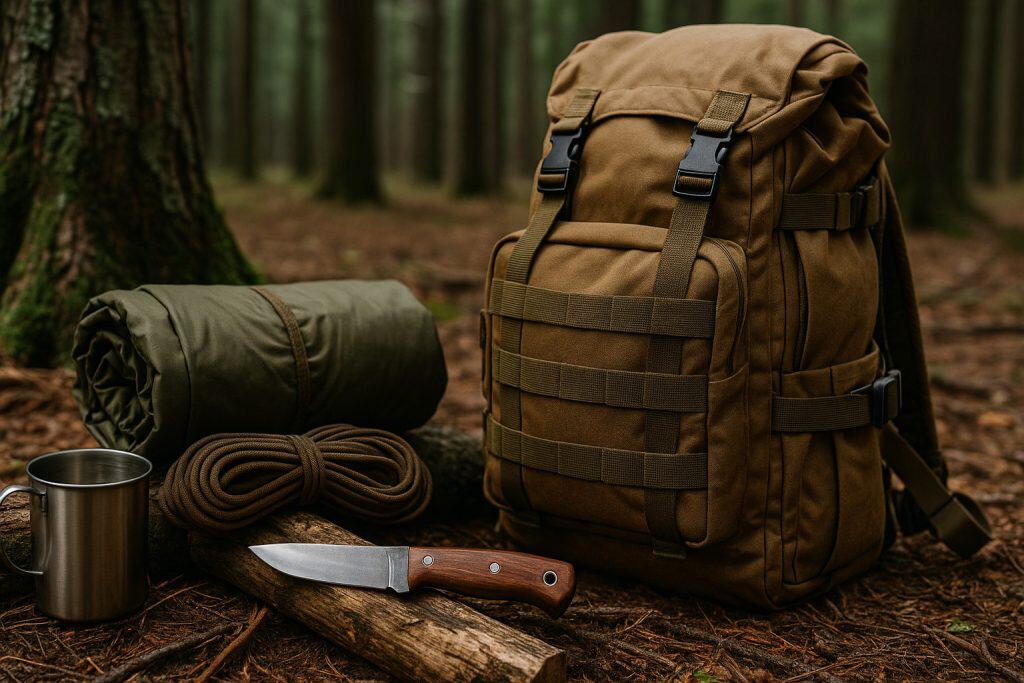
I know a lot of people who use old military style packs such as the MOLLE style pack. These can be a good cost-saving pack if you can get all your gear into it. The only disadvantage I have found with them is the lack of a frame. Again, for me this brings on shoulder and neck fatigue much sooner on longer hikes.
Water Resistance
Beyond frame style considerations, the pack’s ability to keep your gear dry is equally critical when choosing the right bushcraft pack. I would not have a pack that didn’t shed water. There is nothing worse than reaching in your pack for a pair of dry socks only to find they are damp or wet.
Key water resistance features to consider:
- External water-resistant coating (DWR treatment)
- Sealed or taped seams at connection points
- Coverage flaps over zippers
- Integrated rain cover or attachment points for one
- Interior waterproofing system
There are several different ways this is accomplished. Most packs made for hiking use a water-resistant material on the outside, normally ripstop type nylon. This works well as long as there are no holes in the pack. Some manufacturers use a spray-in, rubber-type coating on the inside of the pack. Still others use a plastic liner. (Imagine a very thick freezer bag.)
Each has its advantages. The packs with the plastic liners have a habit of cracking in the creases over time. My preferred method is the spray-in rubber type.
IMPORTANT: Even “waterproof” packs need extra protection in prolonged downpours. Consider packing critical items (sleeping bag, spare clothes) in separate waterproof stuff sacks as a redundant system.
Pockets and Organization
There are as many designs and pocket configurations for packs as there are manufacturers. There are also many different ways to pack your gear into a pack. These things are really personal choices.
I don’t have to have a bunch of accessory pockets because I normally pack all my gear in the main compartment. I am very proficient at packing my gear. You may find a use for several different pockets.
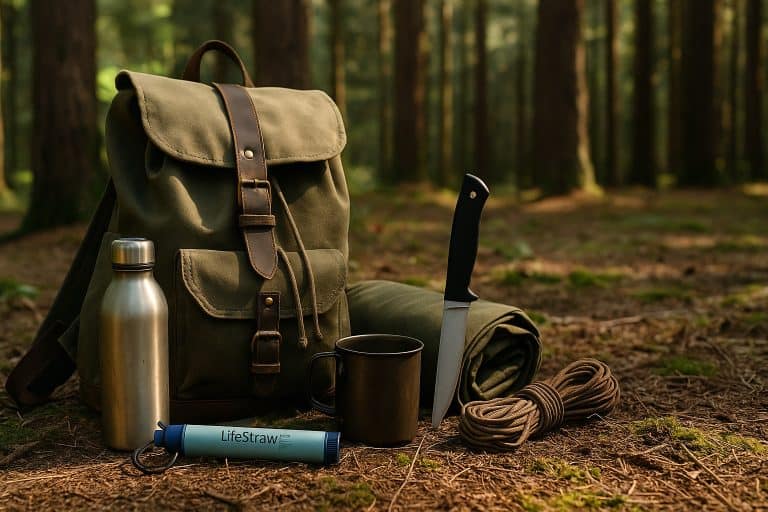
I also want my pack to have a way to attach things externally. To me, this is an important consideration involved in how to choose the right bushcraft pack. There are a few things I like to have on the outside of my pack such as my canteen and cup. I also carry my machete and axe on the outside of my pack when I bring them. If you’re looking for recommendations, we reviewed several affordable bushcraft knives under $50.
Sample Packing Organization
Here’s how I typically organize gear in my pack:
- Bottom zone: Sleeping bag, extra clothes (items not needed until camp)
- Core zone: Heavy items like food bags, cooking equipment, water bladder
- Top zone: Rain gear, first aid kit, navigation tools (items needed frequently)
- Accessory pockets: Snacks, map, compass, headlamp, knife
- External attachments: Water bottles, trekking poles, axe (secured safely)
Keep frequently used items accessible, and pack your heaviest gear closest to your back for better balance when organizing your bushcraft pack.
For more on fire-starting essentials, check out our guide to the best fire starters for wet conditions.
Conclusion
Your pack will be one of the most important things you purchase for your outdoor adventures. I believe in being frugal when you can, but I also believe in spending your money where it will make the most difference. I believe choosing the right bushcraft pack is one of the areas where spending a little more will greatly enhance your enjoyment.
Some may have a different take on what makes a good bushcraft pack, but these are the things that have made the biggest difference for me. What is your favorite type pack? Do you add anything to your criteria for what makes a good pack?
Learning how to choose the right bushcraft pack is an investment in all your future wilderness adventures.